Kana
How to learn hiragana: a calm one-week plan
A realistic plan to learn all 46 hiragana in about a week, with memory pictures, the order to learn them in, and the mix-ups almost everyone makes.
Hiragana is the first thing to learn in Japanese, and it's smaller than it looks: 46 basic characters, each one a single sound. Learn them first and everything after (words, grammar, reading menus) gets easier, because you stop relying on romaji.
Here's a calm plan that fits into 15 to 20 minutes a day. Many learners can recognise all 46 within a week or two this way. Go at your own pace: knowing them well matters more than knowing them fast.
Why not just use romaji?
Romaji (Japanese written in the Latin alphabet) feels easier on day one, but it slows you down later. Textbooks, signs, menus and the JLPT all use Japanese script, and romaji hides sounds that matter, like the difference between おばさん (obasan, aunt) and おばあさん (obaasan, grandmother). The sooner hiragana replaces romaji, the better.
The chart is a grid, so learn it row by row
Hiragana is laid out as a grid: five vowels across, consonants down. Once you know the vowels, every row is "a consonant plus those same five vowels".
Only a handful of sounds break the pattern: し (shi), ち (chi), つ (tsu), ふ (fu), and ん, which is a sound of its own (n).
A one-week plan
- Day 1: vowels (あいうえお) and the K row.
- Day 2: the S and T rows. Review day 1 first.
- Day 3: the N and H rows.
- Day 4: the M, Y and R rows. The Y row has only three: や ゆ よ.
- Day 5: わ, を and ん, then read every row aloud, top to bottom.
- Day 6: mixed practice: read short words, not single characters.
- Day 7: a full check. Note the five you hesitate over most and give them extra time next week.
Each day, spend most of your time on recognising characters (see it, say it), a little on writing them, and always finish by reviewing earlier rows. Little and often beats one long session.
Use a memory picture for every character
The fastest way to make a shape stick is to turn it into a picture with a story. A few examples:
- あ (a): "Aha!" A treasure map: the cross marks the spot, and the loop is the trail circling round it.
- き (ki): an old key, with two notches at the top and a round handle at the bottom.
- ぬ (nu): noodles tangled round a pair of chopsticks, ending in a little loop. Slurp: "noo"!
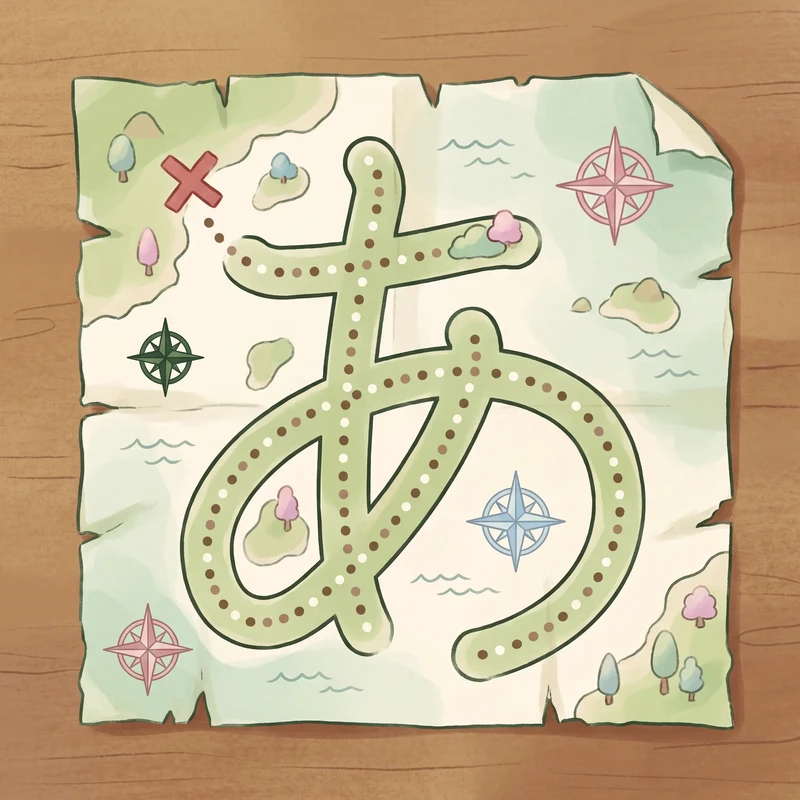
Silly stories are fine; they stick better. Say the sound out loud as you look at the picture, so the shape, the sound and the image all connect.
Write them by hand (a little)
You don't need perfect handwriting, but writing each character a few times, in the right stroke order, helps you notice details you'd otherwise miss, like the small hook on き or the loop on ぬ. Five careful copies beat fifty rushed ones.
The mix-ups almost everyone makes
These pairs look alike. Put them side by side and compare:
- さ (sa) and ち (chi): they're mirror images. The bottom curve of さ opens to the right, like a "c"; ち bulges the other way and opens to the left, like the bottom of a "5".
- ぬ (nu) and め (me): ぬ has a little loop at the end; め doesn't.
- ね (ne), れ (re) and わ (wa): look at the right-hand stroke: ね ends in a loop, れ kicks out, わ curves round.
- る (ru) and ろ (ro): る has a loop at the bottom; ろ doesn't.
- は (ha) and ほ (ho): ほ has an extra line on top.
- い (i) and こ (ko): い is two strokes standing up; こ is two strokes lying down.
After the 46: the extras
Once the basic 46 feel easy, a few small additions unlock every sound in Japanese:
- Two dots (゛, ten-ten) make sounds voiced: か ka → が ga, さ sa → ざ za.
- A small circle (゜, maru) turns the H row into P: は ha → ぱ pa.
- Small や ゆ よ combine sounds: き + ゃ = きゃ (kya).
- Small っ doubles the next consonant: きって (kitte, stamp).
These come quickly because they reuse shapes you already know.
How you'll know you're ready
You're ready to move on when you can read a short word like さくら (sakura, cherry blossom) or まっちゃ (matcha) without sounding out each character. Then start katakana, and keep reading hiragana every day through simple words and phrases.
Hitokuchi's free kana course teaches all 46 hiragana in short lessons, with audio and a memory picture for every character.
Keep reading
 KanaHiragana, katakana and kanji: what each one is forJapanese uses three scripts at once. Here's what hiragana, katakana and kanji each do, why you need all three, and the order to learn them in.
 BasicsJapanese greetings for every time of dayHow to say hello, good morning, goodnight and goodbye in Japanese, when to use each one, and the everyday set phrases Japanese people say at home and work.
 JLPTThe JLPT N5: a beginner's guide to the first Japanese examWhat the JLPT N5 tests, how long each part takes, the pass marks, the 2026 test dates, and how to prepare for it, in plain English.